Sponsors
×
[PR]上記の広告は3ヶ月以上新規記事投稿のないブログに表示されています。新しい記事を書く事で広告が消えます。
Relative Strengh of Bonds
the 1st - Network Crystal the 2nd - Metallic
the 3rd - Ionic
the 4th - Covalent
the 5th - Hydrogen Bonding
the 6th - Dipolar Forces
the 7th - London Forces
(orderd by strangest to weakest)
This a generalization which can be used to place substances in order of Melting points. The higher the melting point, the stronger the bond.
1. Network Crystals
- very high melting points.
- covalently bonded into marro molecules
- contains metalloids but C and Si are most common.
- Carbon is bonded itself as diamond or Graphite
- very hard, stable, non conducters (except graphite "layers")
GEN: If it contains Si or C(by itself) it is network crystal.
m.p. SiC2-2,700℃, Cpia-3500℃
2. Metalic
- Wide range (-39~3,400℃)
- Group 1 and 12 are low
- W-Tungsten is highest
- Ase of delocalized electrons
- Conducts heat, electricity
- Left side of dercodict
- Alloys-Metals with
IMPURITIGS ADDED- Greatly
INCREASES melting points
m.p. OS-2700℃, Ni-1455℃, Li-181℃
3. Ionic
NaCl - m.p. 801℃
NaF - m.p. 988℃
- Not molecules, regular sharped crystals
- Molten compounds conduct
- Dissolve in water to form IONS, and CONDUCT ELEC
- Higher electronegativity diff. Has hiher melting point
- polyatomic ionic compounds are usually weaker
NaF - 988℃, NaI - 651℃, NaOH - 318℃
4. Covalent
- Not involved in melting or boiling points
5. Hydrogen Bonding
- Most contain Hydrogen Bonded to fivorine nitrogen or oxygen
 - Very important in biological systems
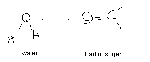
6. Dipolar Forces
Parmanent Dipole
Hcl m.p. -112℃

GEN: The greater the molar mass(size) the greater the melting point.
HI m.p. -50℃, HBr m.p. -88℃, HCr m.p. -112℃
7. London (dispersion forces)
He m.p. -277℃ 1k, Ne m.p. -248℃ 25k
These weak forces are due to temporary induced dipoles

Electrons are further amay from the nucleus, it is easier to induce a dipole, therefore it usually has a higher m.p.
Non polar molecules like CH4, C25H52, CCl4 Are usually placed aith London Forces

If they have a large molar mass, their attractions are strang enogh to became solids at room temperature.
CH4 m.p. -183℃, C6H12 m.p. 6.6℃, C18H38 m.p. 28.2℃,
All substances dissolve in water to a certain extent
Soluble
- HIGH - Na, Cl, Alcohol
- LOW - Ba, CO3, Mg(OH)2
Nonsoluble - Way Oil
Insoluble is an order term for "very low(nonsoluble)"
Why does NaCl Dissolve in water?
- "Like dissolves like"
- "Polar dissolves Polar"

Hydration: Surrounding by water molecules
Why does carbon tetrachloride not dissolve in water?
- "Water molecules want to stick together"

Why does CCl4 dissolve in CS2?>BR?
- "Non polar in Non polar"

It is very easy to break London Forces. The linetic energy (motion) of the Molecules is enough to cause dissolving
How can I speed up dissolving? Heat, stirring
How can I get more to dissolve? Heat
the 1st - Network Crystal the 2nd - Metallic
the 3rd - Ionic
the 4th - Covalent
the 5th - Hydrogen Bonding
the 6th - Dipolar Forces
the 7th - London Forces
(orderd by strangest to weakest)
This a generalization which can be used to place substances in order of Melting points. The higher the melting point, the stronger the bond.
1. Network Crystals
- very high melting points.
- covalently bonded into marro molecules
- contains metalloids but C and Si are most common.
- Carbon is bonded itself as diamond or Graphite
- very hard, stable, non conducters (except graphite "layers")
GEN: If it contains Si or C(by itself) it is network crystal.
m.p. SiC2-2,700℃, Cpia-3500℃
2. Metalic
- Wide range (-39~3,400℃)
- Group 1 and 12 are low
- W-Tungsten is highest
- Ase of delocalized electrons
- Conducts heat, electricity
- Left side of dercodict
- Alloys-Metals with
IMPURITIGS ADDED- Greatly
INCREASES melting points
m.p. OS-2700℃, Ni-1455℃, Li-181℃
3. Ionic
NaCl - m.p. 801℃
NaF - m.p. 988℃
- Not molecules, regular sharped crystals
- Molten compounds conduct
- Dissolve in water to form IONS, and CONDUCT ELEC
- Higher electronegativity diff. Has hiher melting point
- polyatomic ionic compounds are usually weaker
NaF - 988℃, NaI - 651℃, NaOH - 318℃
4. Covalent
- Not involved in melting or boiling points
5. Hydrogen Bonding
- Most contain Hydrogen Bonded to fivorine nitrogen or oxygen
6. Dipolar Forces
Parmanent Dipole
Hcl m.p. -112℃
GEN: The greater the molar mass(size) the greater the melting point.
HI m.p. -50℃, HBr m.p. -88℃, HCr m.p. -112℃
7. London (dispersion forces)
He m.p. -277℃ 1k, Ne m.p. -248℃ 25k
These weak forces are due to temporary induced dipoles
Electrons are further amay from the nucleus, it is easier to induce a dipole, therefore it usually has a higher m.p.
Non polar molecules like CH4, C25H52, CCl4 Are usually placed aith London Forces
If they have a large molar mass, their attractions are strang enogh to became solids at room temperature.
CH4 m.p. -183℃, C6H12 m.p. 6.6℃, C18H38 m.p. 28.2℃,
All substances dissolve in water to a certain extent
Soluble
- HIGH - Na, Cl, Alcohol
- LOW - Ba, CO3, Mg(OH)2
Nonsoluble - Way Oil
Insoluble is an order term for "very low(nonsoluble)"
Why does NaCl Dissolve in water?
- "Like dissolves like"
- "Polar dissolves Polar"
Hydration: Surrounding by water molecules
Why does carbon tetrachloride not dissolve in water?
- "Water molecules want to stick together"
Why does CCl4 dissolve in CS2?>BR?
- "Non polar in Non polar"
It is very easy to break London Forces. The linetic energy (motion) of the Molecules is enough to cause dissolving
How can I speed up dissolving? Heat, stirring
How can I get more to dissolve? Heat
PR